
- Nov 18, 2025
FederalMI vs NCMA: Which Certification Is Right For You
- Federal MI
If you're building a career in government contracting, you've probably seen both FederalMI and NCMA certifications mentioned. Both are respected. Both show up on LinkedIn profiles. But they're built for very different purposes.
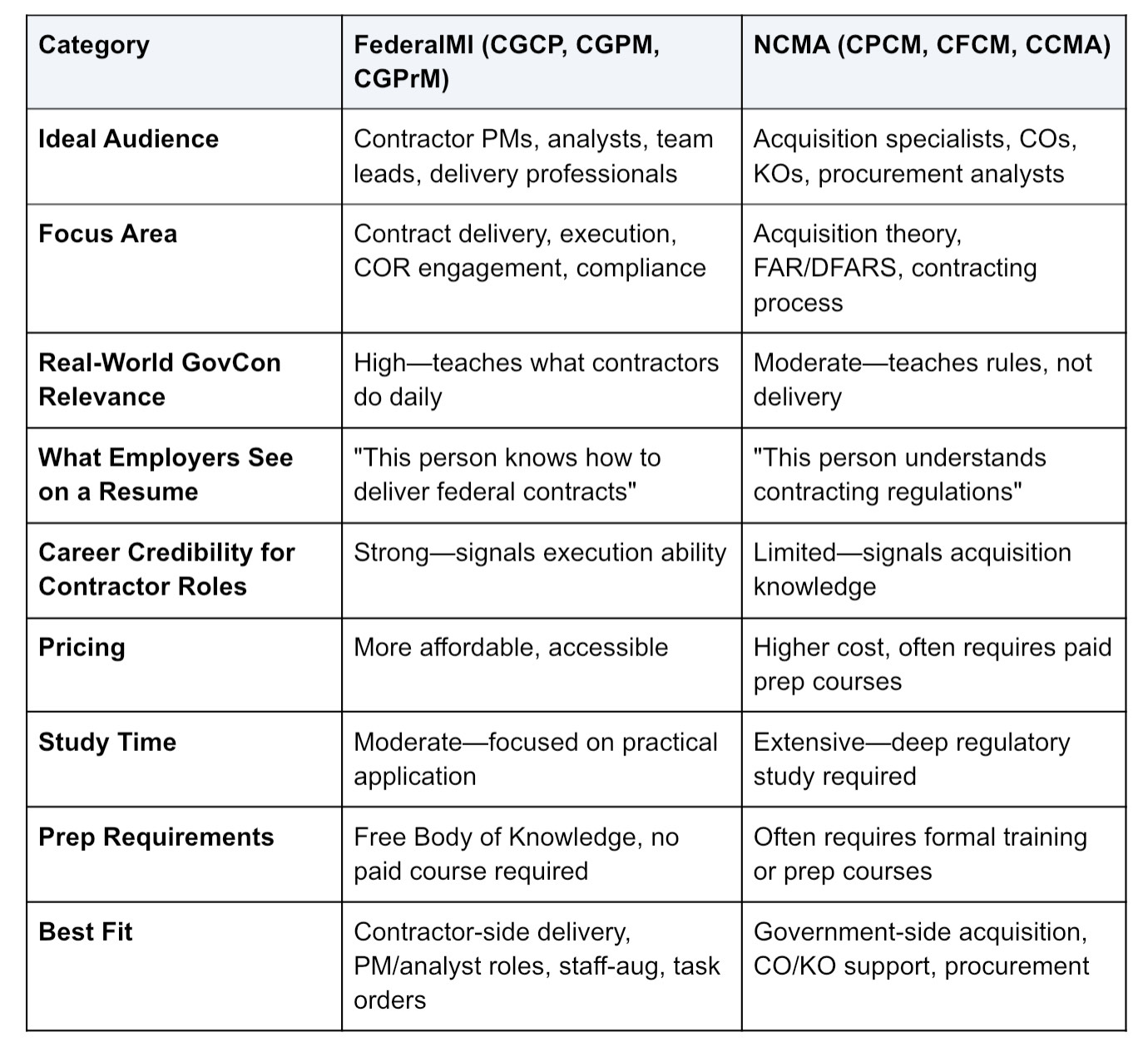
NCMA certifications—like CPCM, CFCM, and CCMA—are designed around acquisition knowledge. They teach FAR, DFARS, and the contracting process from the government's perspective. That's valuable if you're a Contracting Officer, KO, or procurement analyst.
But if you're on the contractor side—delivering federal contracts, managing deliverables, working with CORs, tracking burn rates, or leading task order teams—NCMA doesn't teach what you actually do every day.
That's where FederalMI comes in.
FederalMI govcon certifications—CGCP, CGPM, and CGPrM—are built specifically for contractor-side delivery. They focus on execution: managing scope, staying compliant, reporting performance, engaging CORs, and keeping contracts on track. These are the skills employers look for when hiring or promoting GovCon talent.
This article breaks down both options so you can choose the certification that actually moves your career forward.
Summary Comparison Table
NCMA Certifications: What They Do Well
NCMA has been around for decades. Their certifications—CPCM (Certified Professional Contracts Manager), CFCM (Certified Federal Contracts Manager), and CCMA (Certified Commercial Contracts Manager)—are well-known in the acquisition community.
What NCMA teaches well:
FAR and DFARS regulations
Contract types and structures
Acquisition planning and source selection
Procurement processes and compliance
Legal and regulatory frameworks
If you're a Contracting Officer, KO, or working in a government procurement office, NCMA certifications are highly relevant. They give you the regulatory foundation you need to award and administer contracts from the government's side.
But here's the pivot:
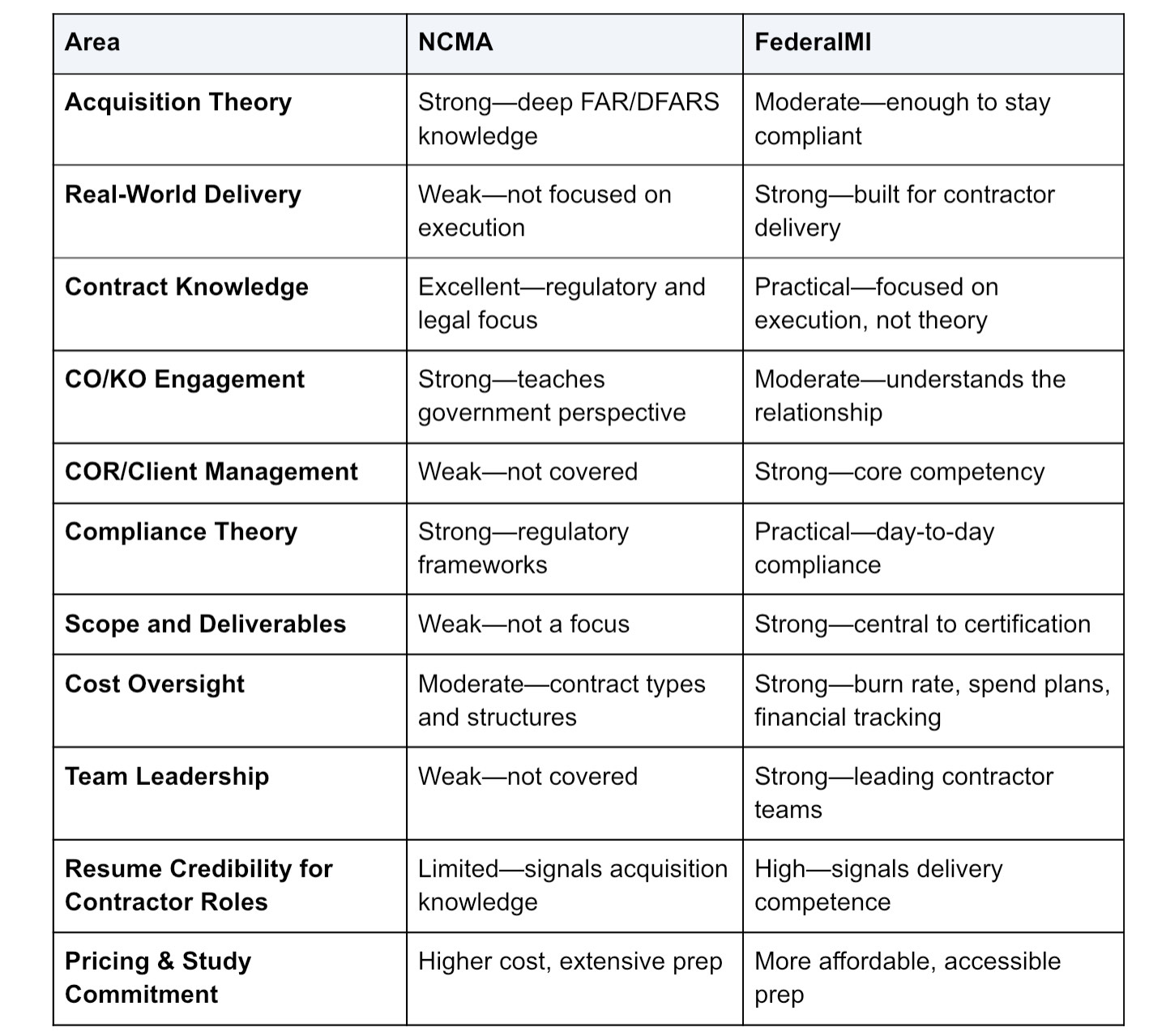
NCMA teaches you about contracts. It doesn't teach you how to deliver them.
If you're a contractor PM, analyst, or team lead, your job isn't to award contracts—it's to execute them. You need to know how to manage deliverables, engage CORs, track burn rates, handle scope creep, report performance, and keep your team compliant.
NCMA doesn't cover those skills.
What NCMA doesn't teach:
How to manage deliverables and milestones
How to engage and communicate with CORs
How to track and manage burn rates and spend plans
How to handle scope creep and contract modifications
How to prepare for CPARS and recompete
How to lead contractor teams through federal delivery cycles
For contractor-side professionals, that's a problem. Employers hiring for delivery roles don't just want someone who knows the FAR—they want someone who can execute.
FederalMI Certifications: What They're Built For
FederalMI certifications—CGCP (Certified Government Contracting Professional), CGPM (Certified Government Project Manager), and CGPrM (Certified Government Program Manager)—are designed specifically for contractor-side delivery.
They teach the skills you actually use on federal contracts:
Core FederalMI competencies:
Managing deliverables and performance reporting
Engaging CORs and managing client expectations
Staying compliant with contract terms and federal regulations
Controlling scope and handling modifications
Tracking burn rates, spend plans, and financial performance
Preparing for CPARS reviews and positioning for recompete
Leading contractor teams through task orders and delivery cycles
These are the skills that separate good GovCon professionals from great ones.
Career impact:
FederalMI credentials signal to employers that you understand how federal contracts are actually delivered—not just how they're awarded.
When a hiring manager sees CGCP or CGPM on a resume, they know the candidate can:
Hit deliverables on time
Keep a contract on track
Work effectively with CORs
Manage compliance without hand-holding
Lead teams through federal delivery challenges
That's what gets you hired. That's what gets you promoted.
FederalMI certifications are built for the people doing the work—PMs, analysts, team leads, and delivery professionals who need to prove they can execute in the GovCon environment.
Side-by-Side Comparison Table
Pricing, Study Time, and Prep Requirements
Let's talk about what it actually takes to earn these certifications.
NCMA certifications:
Cost: NCMA exams are expensive. CPCM and CFCM exams can run several hundred dollars, and many candidates invest in paid prep courses or training programs that add significant cost.
Study time: Extensive. NCMA exams require deep regulatory knowledge. Candidates often spend months studying FAR, DFARS, and acquisition regulations.
Prep requirements: Most candidates use formal training programs, prep courses, or study groups. Self-study is possible but challenging without structured resources.
FederalMI certifications:
Cost: More affordable. FederalMI certifications are priced to be accessible for analysts, team leads, PMs, and delivery professionals at all career stages.
Study time: Moderate. FederalMI exams focus on practical application, not exhaustive regulatory memorization. Study time is focused and efficient.
Prep requirements: FederalMI provides a free Body of Knowledge. No paid prep course required. Resources are designed for working professionals who need to study on their own schedule.
Bottom line:
NCMA requires a significant investment of time and money. FederalMI is built to be accessible, practical, and focused on what you actually need to succeed in contractor-side delivery.
Resume & Career Value
Here's what matters most: What does your certification tell an employer?
NCMA certifications:
NCMA looks impressive if you're applying for acquisition or procurement roles. It signals that you understand contracting regulations and the government's perspective.
But if you're applying for contractor PM, analyst, or team lead roles, NCMA doesn't tell the hiring manager what they need to know.
Employers hiring for delivery roles want proof that you can:
Execute contracts, not just understand them
Manage CORs, not just work with COs
Track deliverables, burn rates, and compliance
Keep contracts on track and clients satisfied
NCMA doesn't signal those skills.
FederalMI certifications:
FederalMI credentials immediately tell an employer:
You understand GovCon execution
You can engage CORs with confidence
You know how to manage compliance and reporting
You can keep contracts on track and deliver results
FederalMI makes your resume stand out for:
Promotions inside GovCon companies
Staff-aug and task order delivery roles
PM and analyst positions
Delivery leadership roles
When a hiring manager sees CGCP, CGPM, or CGPrM on a resume, they think: "This person knows how GovCon work actually happens."
That's what gets you the interview. That's what gets you the offer.
When NCMA Makes Sense
NCMA certifications are valuable for specific roles:
Acquisition specialists who support government procurement offices
Contracting Officers (COs) and Contracting Officer Representatives (KOs) who award and administer contracts
Procurement analysts who work on the government side
If you're in one of these roles—or planning to move into one—NCMA is a strong choice.
But for contractor-side delivery roles, NCMA doesn't signal the skills employers expect.
If your job is to deliver federal contracts, manage teams, engage CORs, and keep projects on track, NCMA won't prepare you for that work—and it won't help your resume stand out.
When FederalMI Is the Better Fit
FederalMI certifications are ideal for:
Contractor PMs, analysts, and team leads who manage federal delivery
T&M, staff-aug, and task order professionals who work directly with CORs
Anyone responsible for deliverables, burn rates, and performance reporting
Professionals who want career advancement inside GovCon firms
Candidates who need a resume credential that shows real GovCon competence
If you're on the contractor side—or planning to be—FederalMI is the certification that will actually help you succeed.
It teaches the skills you use every day. It signals to employers that you can execute. And it positions you for career growth in the GovCon industry.
Real GovCon Scenarios
Let's look at a few real-world situations where NCMA and FederalMI credentials play out differently.
Scenario 1: Scope Creep
Your COR keeps asking for deliverables that aren't in the contract. The team is burning hours on out-of-scope work, and your burn rate is climbing.
NCMA: Teaches you the FAR clauses around contract modifications. You know the rules.
FederalMI: Teaches you how to have the conversation with the COR, document the scope issue, and escalate appropriately without damaging the relationship. You know how to solve the problem.
Scenario 2: Burn Rate Issues
You're three months into a six-month task order, and you've already burned 60% of your budget. The COR is asking why deliverables are behind schedule.
NCMA: Teaches you contract types and cost structures. You understand the theory.
FederalMI: Teaches you how to track burn rates, adjust spend plans, communicate with the COR, and get the contract back on track. You know how to fix it.
Scenario 3: CPARS Review
Your contract is up for recompete, and your CPARS rating will determine whether you win the follow-on.
NCMA: Teaches you the CPARS process and evaluation criteria. You know what CPARS is.
FederalMI: Teaches you how to manage performance throughout the contract, engage the COR proactively, and position your team for a strong CPARS rating. You know how to earn the rating.
The difference:
NCMA gives you the rules. FederalMI gives you the skills to execute.
Closing Summary
Both FederalMI and NCMA certifications have value—but they serve very different purposes.
NCMA is excellent for contracting theory. If you're working in acquisition, procurement, or government-side contracting, NCMA certifications give you the regulatory foundation you need.
FederalMI is what actually helps contractors deliver, perform, and stand out to employers in the GovCon industry.
If you're on the contractor side—managing deliverables, engaging CORs, tracking burn rates, leading teams, or positioning for career growth—FederalMI certifications teach the skills you use every day and signal to employers that you can execute.
NCMA teaches you about contracts. FederalMI teaches you how to deliver them.
Choose the certification that matches the work you do—and the career you want.