
- Nov 20, 2025
FederalMI vs Scrum Master and Product Owner
- Federal MI
If you're working in government contracting—or trying to break in—you've probably asked yourself whether you should pursue a Scrum Master certification, a Product Owner credential, or something built specifically for federal delivery.
It's a fair question. Agile certifications like CSM, PSM, CSPO, and PSPO are everywhere. They're respected in software development and private industry. They teach valuable frameworks for iterative delivery, backlog management, and team collaboration.
But here's the reality: Scrum teaches a method. FederalMI explains how federal contracts are actually delivered.
In GovCon, compliance matters more than ceremonies. COR expectations matter more than sprint retrospectives. Documentation, burn rate tracking, and scope control matter more than velocity charts.
If you're a contractor PM, analyst, or team lead working inside a federal agency, you need to understand how government contracts work—not just how Agile teams work.
That's the difference between Agile certifications and FederalMI certifications, such as the CGCP, CGPM, and CGPrM.
This article breaks down both options so you can decide which certification actually helps you succeed in GovCon delivery.
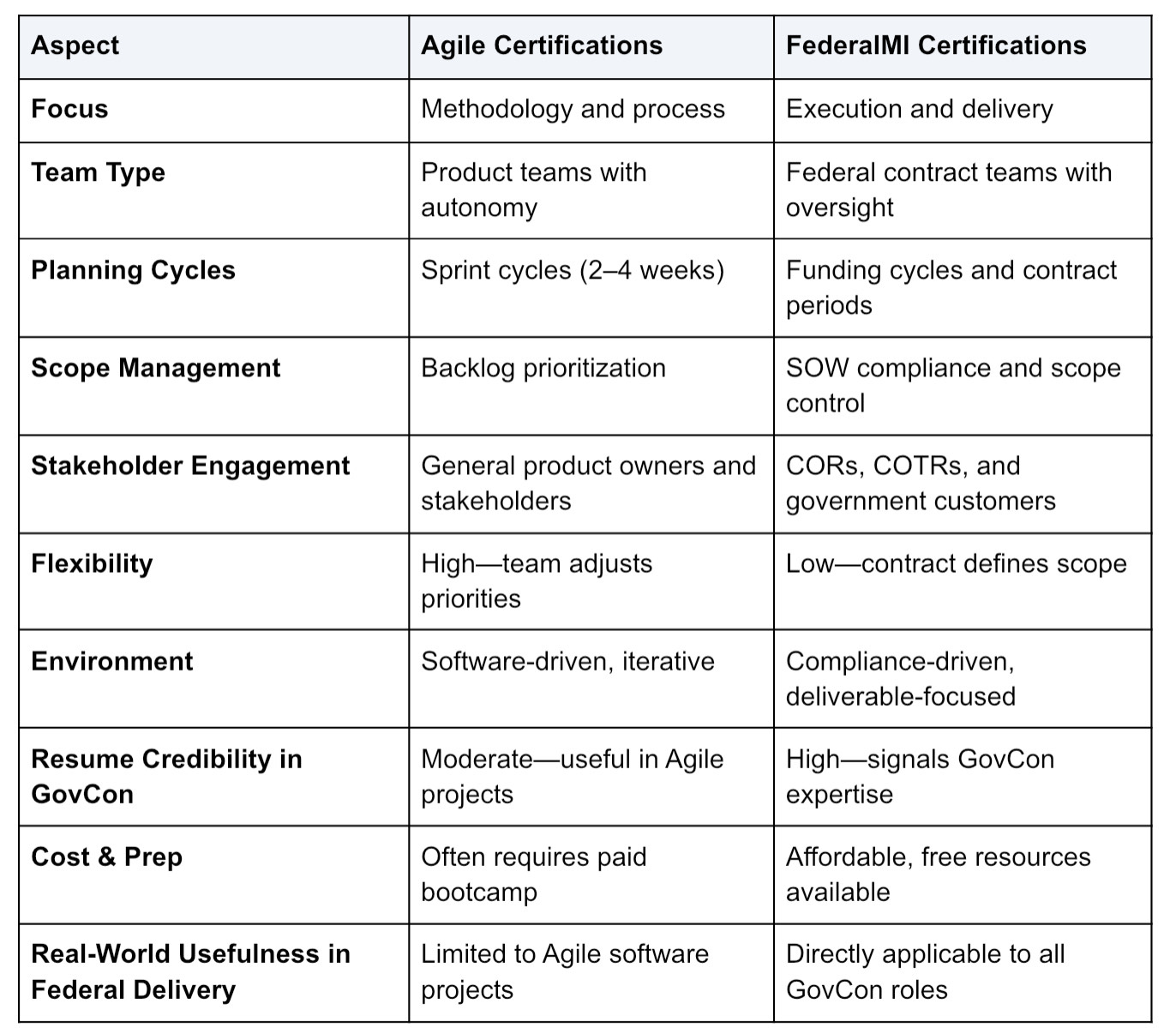
Summary Comparison Table

Agile Certifications: What They Do Well
Agile certifications like CSM, PSM, CSPO, and PSPO teach iterative delivery. They focus on sprint planning, backlog refinement, team ceremonies, and product thinking. They're well-respected in software development and commercial sectors.
If you're working on a product team in a tech company, these credentials make sense. They teach you how to manage backlogs, run standups, and facilitate retrospectives.
But here's what they don't teach:
How to engage with a COR or COTR
How to interpret a SOW or PWS
How to control scope when the customer asks for something outside the contract
How to track burn rate or manage a spend plan
How to handle timekeeping and compliance rules in a staff-aug environment
How to position your team for CPARS or recompete
How to navigate government budgeting and approval cycles
Agile certifications assume you're working in a flexible, product-driven environment where the team controls priorities and scope.
Federal contracts don't work that way.
In GovCon, the contract defines the scope. The COR defines success. The funding controls what you can do and when. And compliance isn't optional.
Agile certifications teach you how to run sprints. They don't teach you how to deliver federal contracts.
FederalMI Certifications: What They're Built For
FederalMI certifications—CGCP (Certified Government Contract Professional), CGPM (Certified Government Project Manager), and CGPrM (Certified Government Program Manager)—are built specifically for federal contract delivery.
They teach the skills GovCon PMs, analysts, and delivery teams actually need:
Managing deliverables and performance against the SOW
Communicating effectively with CORs and government stakeholders
Controlling scope in T&M and staff-augmentation contracts
Handling compliance, documentation, and reporting requirements
Tracking burn rate, funding, EAC, ETC
Leading contractor teams inside federal agencies
Supporting CPARS and positioning for recompete
These certifications signal to employers that you understand GovCon delivery—not just Agile ceremonies.
When a hiring manager sees FederalMI credentials on your resume, they know you understand:
How federal contracts work
How to work with CORs
How to manage scope and compliance
How to deliver results in a government environment
That's exactly what GovCon employers look for when hiring PMs, analysts, or team leads.
Side-by-Side Comparison Table
Pricing, Study Time, and Prep Requirements
Agile certifications often require paid training. A CSM or CSPO bootcamp can cost $1,000 or more. PSM and PSPO exams are cheaper, but many candidates still pay for prep courses. SAFe certifications can run $500–$1,500, depending on the level.
Study time varies. Some candidates pass after a two-day bootcamp. Others spend weeks preparing. Many Agile certifications also require ongoing renewals and fees.
FederalMI certifications are more affordable. They don't require a mandatory prep course. FederalMI provides free resources, including a comprehensive Body of Knowledge that covers everything you need to know.
You can study at your own pace. You can prepare on your own schedule. And you don't need to pay for expensive bootcamps or training programs.
This makes FederalMI accessible to PMs, analysts, team leads, and consultants who want to build GovCon expertise without breaking the bank.
Resume & Career Value
Agile certifications look good on a resume—especially for software teams. But most federal contractors don't work inside true Agile organizations.
They work in staff-aug roles. They work on T&M contracts. They report to CORs. They manage deliverables, not backlogs. They track burn rate, not velocity.
Employers in GovCon want candidates who understand:
Working alongside federal staff and being a trusted advisor
Working within complex federal regulations and compliance concerns
Meeting contractual exceptions
Working in a co-employment environment around other contractors and federal staff
FederalMI certifications stand out because they communicate GovCon execution capability. They tell employers you know how to deliver federal contracts—not just how to run Agile ceremonies.
When you're competing for a GovCon PM or analyst role, FederalMI credentials give you an edge. They show you understand the environment. They show you can handle the complexity. They show you're ready to deliver.
That's what gets you hired.
When Agile Certifications Make Sense
Agile certifications are helpful in specific GovCon contexts:
Software development teams working in Agile environments
Development-heavy federal programs with iterative delivery models
Hybrid product environments where Agile practices are embedded
IT modernization initiatives that use Agile frameworks
If you're working on a federal software project with an actual Agile structure, a CSM or CSPO can help you contribute effectively.
But Agile alone does not prepare you for federal contract delivery. It doesn't teach you how to manage scope, engage with CORs, track burn rate, or handle compliance.
That's where FederalMI fills the gap.
When FederalMI Is the Better Fit
FederalMI certifications are ideal for:
Contractor PMs, analysts, and team leads
Professionals working in T&M or staff-augmentation roles
Anyone who reports to CORs or government customers
People responsible for burn rate, hours, or funding
Those supporting deliverables, reporting, and CPARS
Job seekers who want a credential that signals GovCon expertise
Anyone accountable for performance and contract success
If your job involves delivering federal contracts—not just running Agile ceremonies—FederalMI is the better fit.
Closing Summary
Agile certifications are excellent for software teams and product-driven environments. They teach valuable frameworks for iterative delivery and team collaboration.
But in GovCon, Agile alone isn't enough.
Federal contracts require compliance, scope control, COR engagement, burn rate management, and deliverable-focused execution. They need professionals who understand how government contracts work—not just how Agile teams work.
FederalMI certifications teach those skills. They prepare you for the realities of federal contract delivery. They help you succeed with CORs, manage scope, track funding, and position your team for CPARS and recompete.
And they help you stand out to GovCon employers who need professionals who can actually deliver.